The request passed authorization. The job was dispatched. The user lost access. And the application kept working as if nothing had changed.
Most Laravel security discussions start with HTTP requests.
Developers inspect middleware, validate input, configure CSRF protection, escape Blade output, and check whether controllers authorize access to sensitive resources.
That’s important. But there’s a problem with this approach:
A modern Laravel application does much more than respond to HTTP requests.
A request can dispatch a job that runs several minutes later. An event can trigger multiple listeners. A notification can deliver information to a user whose permissions have already changed. A cached response can outlive the authorization decision that created it.
The original request may have been perfectly secure.
The operations it started may not be.
This article explores five less obvious security boundaries in Laravel applications and shows how to make them explicit, testable, and reliable.
1. The Stale Authorization Problem: When Permissions Change After Dispatch
Consider a SaaS application where managers can export customer reports.
The implementation looks reasonable:
public function export(
    Request $request,
    Report $report
): JsonResponse {
    Gate::authorize('export', $report);

    ExportReportJob::dispatch(
        $report->id,
        $request->user()->id
    );

    return response()->json([
        'message' => 'Export started.',
    ]);
}
The user is authorized. The job is dispatched. Everything looks good.
But imagine this sequence:
- Alice has permission to export a report.
- Alice requests an export.
- Laravel puts the job into Redis.
- An administrator revokes Alice’s permission.
- The queue worker picks up the job.
- The export is generated anyway.
The application checked authorization at dispatch time, not execution time.
That distinction matters.
A queued job is not simply a continuation of the original HTTP request. It is a separate execution context that may run after the original security assumptions have become invalid.
The better approach
Pass identifiers to the job and resolve the relevant entities when the job executes.
final class ExportReportJob implements ShouldQueue
{
    public function __construct(
        private readonly int $reportId,
        private readonly int $userId,
    ) {}

    public function handle(): void
    {
        $user = User::findOrFail($this->userId);
        $report = Report::findOrFail($this->reportId);
        Gate::forUser($user)->authorize('export', $report);
        app(ReportExporter::class)->export($report);
    }
}
Now the authorization decision happens at execution time.
The policy can evaluate the user’s current permissions, account status, tenant membership, and relationship with the report.
This is especially important for:
- Financial exports.
- Personal data processing.
- Administrative operations.
- Account suspension.
- Permission revocation.
- Long-running background tasks.
A permission granted five minutes ago is not necessarily a permission that should still exist now.
There is one additional consideration: some jobs represent an operation that was explicitly approved at dispatch time. In that case, the application should model that approval as a durable business authorization record rather than accidentally relying on stale user permissions.
2. Cache Poisoning Through Incorrect Security Context
Caching is one of the easiest ways to improve Laravel performance.
It is also an easy way to introduce cross-user data exposure.
Imagine a dashboard endpoint:
public function dashboard(Request $request): JsonResponse
{
    $data = Cache::remember(
        'dashboard',
        now()->addMinutes(10),
        fn () => app(DashboardService::class)
            ->forUser($request->user())
    );

    return response()->json($data);
}
The code works.
Until two different users request the dashboard.
The cache key is identical for everyone.
If the first user receives sensitive data, the second user may receive exactly the same cached response.
The problem isn’t Redis.
The problem is that the cache key does not represent the security context of the cached data.
A safer implementation
public function dashboard(Request $request): JsonResponse
{
    $user = $request->user();

    $cacheKey = sprintf(
        'dashboard:tenant:%d:user:%d',
        $user->tenant_id,
        $user->id
    );

    $data = Cache::remember(
        $cacheKey,
        now()->addMinutes(10),
        fn () => app(DashboardService::class)
            ->forUser($user)
    );

    return response()->json($data);
}
This is better, but it is not a universal solution.
Depending on the application, the cache key may also need to include:
- Role or permission version.
- Selected organization.
- Resource visibility scope.
- Locale.
- Feature configuration.
- Data version.
There is another subtle issue: permission revocation.
Suppose a user loses access to a project, but the cached dashboard remains valid for another ten minutes.
The authorization system may be correct while the cached representation is not.
For sensitive data, consider versioned cache keys or explicit invalidation when access changes.
For example:
$cacheKey = sprintf(
    'dashboard:user:%d:permissions:%d',
    $user->id,
    $user->permissions_version
);
Whenever permissions change, increment the version.
Old cache entries become unreachable without requiring an expensive search through every possible cache key.
A cache key is part of your security model. Treat it accordingly.
3. Events and Notifications Can Become Data-Leak Pipelines
Laravel events encourage decoupled architecture.
A controller dispatches an event, and several listeners react to it.
For example:
event(new InvoiceApproved($invoice));Possible listeners might:
- Generate a PDF.
- Send an email.
- Notify an account manager.
- Update analytics.
- Publish a broadcast event.
- Synchronize data with an external service.
This architecture is convenient, but it creates a question:
Who is allowed to receive the information produced by these listeners?
Consider an invoice notification.
At the time the invoice is approved, a manager is allowed to access it.
The notification is queued.
Before the worker processes it, the manager is removed from the organization.
If the notification contains sensitive invoice information, the application may deliver data to someone who no longer has access.
Don’t confuse the original event with permanent permission
An event describes something that happened.
It does not automatically grant every listener permanent permission to disclose the associated data.
For sensitive notifications, resolve the recipient and verify access as close as possible to delivery.
final class InvoiceApprovedNotification extends Notification
    implements ShouldQueue
{
    public function __construct(
        private readonly int $invoiceId,
    ) {}

    public function toMail(User $notifiable): MailMessage
    {
        $invoice = Invoice::findOrFail($this->invoiceId);
        Gate::forUser($notifiable)->authorize(
            'view',
            $invoice
        );
        return (new MailMessage())
            ->subject('Invoice approved')
            ->line('Your invoice has been approved.')
            ->action(
                'View invoice',
                route('invoices.show', $invoice)
            );
    }
}
The exact design depends on the notification channel and whether the message is rendered before or during delivery.
For particularly sensitive information, avoid placing confidential data directly into queued notification payloads. Prefer storing an identifier and retrieving the information only after authorization.
Also review broadcast channels.
A channel authorization callback should not merely establish that a user is authenticated. It should verify that the user is currently allowed to subscribe to the specific resource.
Broadcast::channel(
    'invoices.{invoice}',
    function (User $user, Invoice $invoice): bool {
        return Gate::forUser($user)->allows('view', $invoice);
    }
);
This makes the resource-level authorization decision explicit.
4. Webhooks: The Same Event Can Become a Different Attack
Webhooks are an essential integration mechanism.
Payment providers, CRM systems, delivery platforms, and external services send events to your Laravel application.
A common implementation looks like this:
public function handle(Request $request): Response
{
    $payload = $request->all();

    PaymentProcessedJob::dispatch($payload);

    return response()->noContent();
}
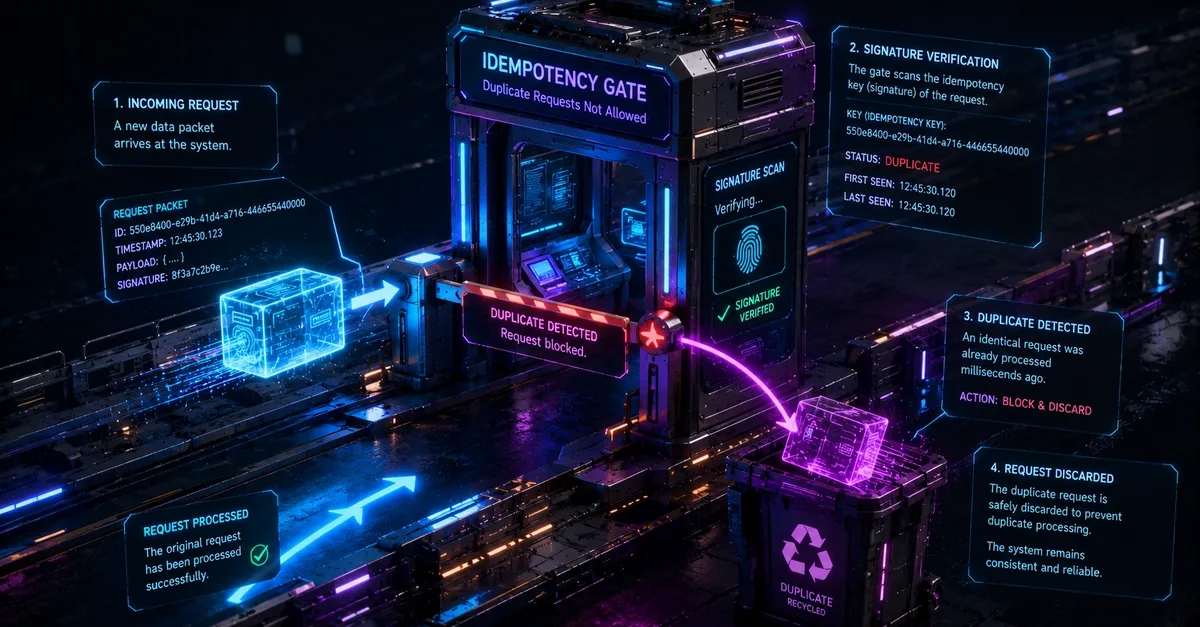
But what happens if the provider sends the same event twice?
Or ten times?
Or if an attacker replays a previously valid request?
A webhook signature proves that a request came from a trusted sender and has not been modified, assuming the signature verification is implemented correctly.
It does not prove that the event has never been processed before.
Build replay protection into the data model
A basic event table might look like this:
Schema::create('webhook_events', function (Blueprint $table) {
    $table->id();

    $table->string('provider');
    $table->string('external_event_id');
    $table->timestamp('processed_at')->nullable();
    $table->timestamps();
    $table->unique([
        'provider',
        'external_event_id',
    ]);
});
The unique constraint is important.
An application-level check alone is not sufficient when two identical webhook requests arrive simultaneously.
Both requests may check that the event does not exist before either inserts it.
The database must enforce uniqueness.
A simplified processing flow:
DB::transaction(function () use ($provider, $eventId) {
    $event = WebhookEvent::query()->firstOrCreate([
        'provider' => $provider,
        'external_event_id' => $eventId,
    ]);

    if ($event->processed_at !== null) {
        return;
    }

    Payment::query()
        ->where('provider_event_id', $eventId)
        ->update([
            'status' => PaymentStatus::Completed,
        ]);
    $event->update([
        'processed_at' => now(),
    ]);
});
This is only an illustrative starting point. Production implementations must also handle concurrent workers, database uniqueness violations, provider-specific event ordering, and external side effects.
For example, sending an email or calling another payment API inside a database transaction does not make that external operation transactional.
A robust implementation often combines:
- Signature verification.
- Provider event IDs.
- Database unique constraints.
- Atomic state transitions.
- Idempotent business operations.
- Transactional outbox patterns for external side effects.
Exactly-once delivery should never be your assumption. Idempotent processing should be your design goal.
5. Business State Is a Security Boundary Too
Developers often focus on who can perform an action.
But there is another question:
Is this action valid in the current business state?
Consider an order approval workflow.
A manager can approve orders.
A basic policy might check:
return $user->hasPermissionTo('orders.approve');That verifies the user’s permission.
It says nothing about whether the order is actually eligible for approval.
What if the order is:
- Already cancelled?
- Already approved?
- Under investigation?
- Awaiting another approval?
- Owned by a different tenant?
Authorization and business-state validation are different responsibilities.
Make transitions explicit
Instead of allowing arbitrary status updates:
$order->update([
    'status' => $request->input('status'),
]);
Use explicit domain operations:
final class ApproveOrder
{
    public function execute(
        User $user,
        int $orderId
    ): Order {
        return DB::transaction(function () use (
            $user,
            $orderId
        ) {
            $order = Order::query()
                ->lockForUpdate()
                ->findOrFail($orderId);

            Gate::forUser($user)->authorize(
                'approve',
                $order
            );

            if ($order->status !== OrderStatus::Pending) {
                throw new DomainException(
                    'Only pending orders can be approved.'
                );
            }

            $order->update([
                'status' => OrderStatus::Approved,
                'approved_by' => $user->id,
                'approved_at' => now(),
            ]);

            return $order;
        });
    }
}
The database transaction and row lock help prevent competing operations from approving the same order based on an outdated state.
For more complex workflows, consider explicit state machines or domain-level transition services.
A good transition should answer three questions:
- Who is allowed to perform it?
- Is the transition valid from the current state?
- Can concurrent requests violate the invariant?
This is especially important in financial applications, marketplaces, booking systems, and enterprise approval workflows.
6. Turn Security Assumptions Into Negative Tests
One of the most useful changes a team can make is to stop testing only successful scenarios.
A typical feature test might verify:
$this->actingAs($manager)
    ->postJson('/api/orders/123/approve')
    ->assertOk();
That’s necessary, but insufficient.
Security is often demonstrated by proving that something cannot happen.
For every sensitive operation, test the negative path.
ScenarioExpected resultUser loses permission after job dispatchJob cannot perform the protected operationUser from another tenant requests a reportAccess deniedTwo identical webhooks arrive simultaneouslyBusiness operation happens onceUser loses access after cache populationSensitive cached data is not returnedNotification recipient loses accessSensitive information is not disclosedTwo requests approve the same orderOnly one valid transition succeeds
For example, a cross-tenant test:
public function test_user_cannot_export_another_tenants_report(): void
{
    $tenantA = Tenant::factory()->create();
    $tenantB = Tenant::factory()->create();

    $user = User::factory()
        ->for($tenantA)
        ->create();
    $report = Report::factory()
        ->for($tenantB)
        ->create();

    $this->actingAs($user)
        ->postJson("/api/reports/{$report->id}/export")
        ->assertForbidden();
}
The important part is not the specific assertion.
It is the security invariant being tested.
For multi-tenant systems, this deserves particular attention: tenant isolation must survive not only HTTP requests, but also queues, caches, broadcasts, storage, and other shared resources.
OWASP’s multi-tenant security guidance describes these risks across multiple layers of an application: Multi-Tenant Security Cheat Sheet.
7. A Practical Security Review for Laravel Teams
Instead of reviewing only controllers and middleware, trace sensitive data through the entire application.
For each critical resource — invoices, payments, reports, documents, customer records — ask:
HTTP layer
- Is the user authenticated?
- Is resource-level authorization enforced?
- Is tenant ownership verified?
Queue layer
- Is authorization checked again when the job executes?
- Can a stale job perform an operation after access is revoked?
- Can duplicate jobs cause duplicate business operations?
Event and notification layer
- Can listeners disclose data to unauthorized recipients?
- Are broadcast subscriptions protected by resource-level authorization?
- Are sensitive payloads stored unnecessarily in queued messages?
Cache layer
- Does the cache key include the relevant security context?
- What happens when permissions or tenant membership change?
- Can one user receive another user’s cached response?
Integration layer
- Are webhook signatures verified?
- Are duplicate events handled safely?
- Are state transitions protected against replay and concurrency?
Business logic
- Are invalid state transitions rejected?
- Can two concurrent requests violate a business invariant?
- Are critical operations auditable?
If the answer to any of these questions is unclear, you probably have a security assumption that needs to become explicit.
Final Thoughts: Security Is a Property of the Entire Execution Flow
Laravel provides excellent building blocks.
Policies, queues, events, transactions, cache drivers, broadcasting, and database constraints make it possible to build secure applications without reinventing everything.
But the framework cannot automatically understand every business rule.
It cannot know that a manager has just been removed from an organization, that an invoice has already been approved, or that a webhook has already triggered a payment.
Those are application-level responsibilities.
The most dangerous security gaps are not always in the code that receives the request.
Sometimes they are several steps later, in a background worker, a cached response, a notification, or a concurrent state transition.
A useful rule for every Laravel team:
Never assume that an authorization decision remains valid just because the operation started from an authorized request.
Review the entire execution flow. Test what must never happen. Make security invariants explicit.
Because a secure controller does not automatically make a secure application.

Комментарии (0)
Пока нет комментариев — будьте первым.